
Fulfillment
One warehouse or two? Transit maps from Brooklyn to every US zone
One warehouse covers about three quarters of the country within three or four ground days from Brooklyn. Here is the zone penalty the far coast adds to every label, the order-share thresholds 3PLs publish for a second site, what the second node really costs, and the air-upgrade middle step.

One warehouse is enough until a large share of your orders ride ground for four or five days. The thresholds 3PLs publish for adding a second site cluster between 25% and 40% of orders going to the far coast. From Brooklyn, the far coast is the West, where 23% of the US population lives. Below that share, keep one inventory pool and upgrade the orders that matter to air.
What one Brooklyn warehouse reaches by ground
Unishippers' UPS Ground guide (Apr 2, 2026) puts zones 1 and 2 at one business day, zones 3 and 4 at two, zones 5 and 6 at three to four, and zones 7 and 8 at four to five. From 905 Remsen Ave that means New Jersey tomorrow, the rest of the Northeast in two days, the Midwest and Southeast in three or four, and the West Coast in four or five.
The Census Bureau's July 1, 2025 estimates (released Jun 25, 2026) put 58.0 million people in the Northeast, 69.8 million in the Midwest, 133.8 million in the South and 80.1 million in the West, out of 341.8 million. About three quarters of the country is within three or four ground days of Brooklyn. Two-day delivery without Amazon covers the promise. This article is about the money.
What the far zones cost on every label
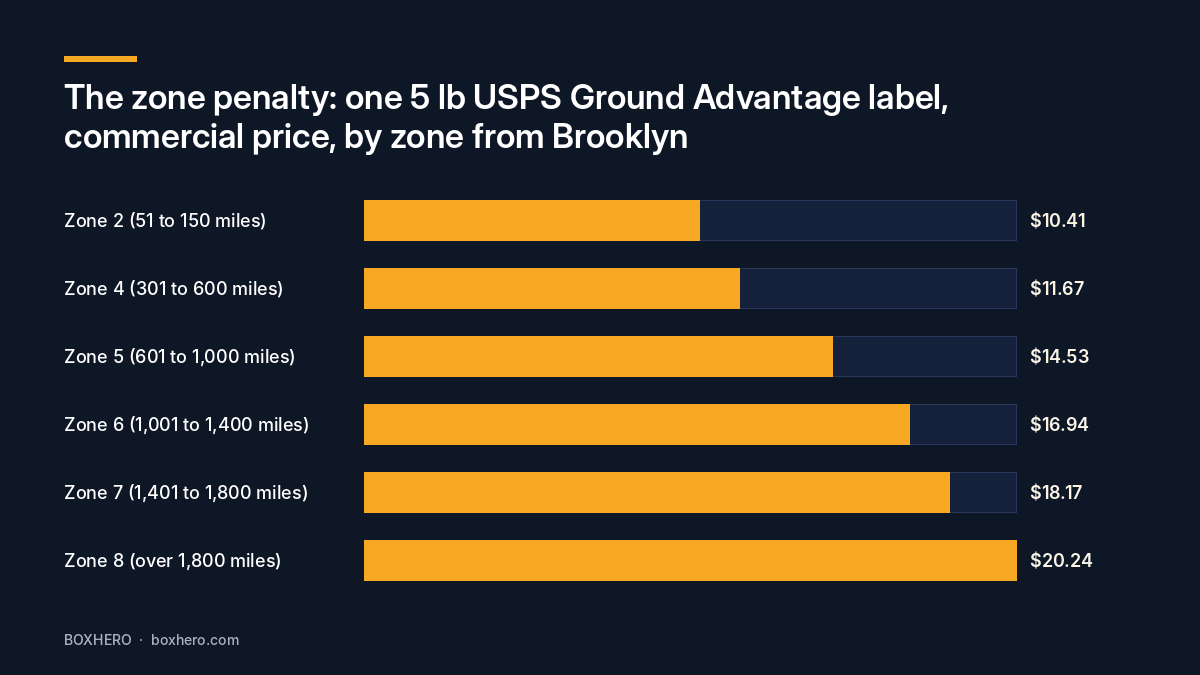
USPS Notice 123, effective Oct 4, 2026, prices a 5 lb Ground Advantage label at the commercial rate at $10.41 in zone 2, $11.67 in zone 4, $14.53 in zone 5, $16.94 in zone 6, $18.17 in zone 7 and $20.24 in zone 8. The zone 8 label costs $9.83 more than the zone 2 label. For a 2 lb label the spread is $8.48 to $13.42, or $4.94. That gap is the zone penalty of serving the West from Brooklyn, and it is the number a second warehouse has to earn back. Zones are distance bands from the origin ZIP: zone 2 is 51 to 150 miles, zone 8 is over 1,800. Chicago is zone 5 from our ZIP, Los Angeles zone 8. Dimensional weight widens the gap on bulky, light boxes.
The thresholds 3PLs publish for a second site
| Source | Trigger for a second warehouse | What else it says |
|---|---|---|
| 3PL Center (May 29, 2026, updated Nov 16) | 25% to 35% of orders crossing the country | Split stock 55/45 or 60/40. Minimums and account fees double before the first order ships. Ramp-up 2 to 4 weeks with the same 3PL, 6 to 8 with a second one. |
| Olimp Warehousing (Mar 19, 2026, updated Jul 6) | 30% to 40% of orders to the opposite coast | Example: 1,500 orders a month, 35% to the far coast, $2.25 saved per order, about $1,180 a month in postage. |
| ShipAid (Sep 17, 2026) | Under 10% to 15% of orders in the new region: wait | Count a 1 to 3 point conversion lift, amortize setup over 12 to 18 months. |
| ShipBob (updated Oct 23, 2026) | When shipping savings exceed the cost of the added space | Send only best sellers to the second site. Ample Foods went from 32% to 65% two-day reach and reported a 13% saving. |
The 3PL Center post behind this question (May 8, 2026) frames it from the other coast: East Coast customers waiting four to five days on a West Coast warehouse. Brooklyn is the mirror image.
What the second node costs
Three costs sit against the saving. Fixed fees first: Fulfill.com (updated Nov 12, 2026) puts the average 3PL monthly minimum at $517 in its 2025 survey, pallet storage at $20.17 a month and receiving at $10.52 a pallet. A second node pays those again every month, West orders or not.
Inventory second. Safety stock follows the square-root law: pooled stock for n independent locations is 1/√n of the decentralized total, as MetricGate's risk-pooling note (Jun 2, 2026) lays out. Run it the other way and splitting one pool into two means about 41% more safety stock for the same service level. That is our arithmetic on the formula and it covers safety stock only.
Management third: two sets of cycle counts and a one-to-two-week lag when stock moves between sites, per 3PL Center. How many orders a month before a 3PL pays off shows what one $517 minimum does per order. A second node runs that math twice.
A worked example from Remsen Avenue
Take 1,500 orders a month with the West at 23%, the national population share. That is 345 orders in zones 7 and 8. On a 5 lb box the postage saving from a West node is at most $9.83 an order, about $3,390 a month before surcharges. On a 2 lb box it is $4.94 an order, about $1,700. Against that: a second $517 minimum, duplicated storage and receiving, 41% more safety stock on the split SKUs, and rebalancing moves. The 5 lb brand probably clears the bar. The 2 lb brand is close, and turns on how many SKUs it would stock twice. Below 15% of orders in the West, neither clears it, which matches ShipAid's floor. These figures are our arithmetic on the rates above.
The air upgrade is the cheaper middle step
Until the West share justifies a node, buy speed by the order instead of by the building. AtoShip's 2026 estimates (Mar 4, 2026) put a 5 lb box at about $20 by UPS Ground to zone 8 and $28 to $38 by 2nd Day Air at retail. That is $8 to $18 more, paid only on the orders you choose. The example rule on our rate shopping page reads "orders over $150 arrive in 2 days, everything else cheapest carrier arriving in 5 days". It upgrades the orders with margin and leaves the rest on ground, with one pool of stock. Regional carriers shorten the map too: on a 2 lb Brooklyn to Chicago example, SpeedX quotes 3 business days at $5.04 (more on regional carriers).
The decision in four steps
- Pull the last 12 months of orders by state and count the share in zones 7 and 8 from your warehouse's ZIP.
- Multiply those orders by the zone penalty for your typical weight: $4.94 at 2 lb, $9.83 at 5 lb on USPS commercial rates. That is the gross monthly saving.
- Subtract the second node's minimum, duplicated storage and receiving, rebalancing, and the 41% safety-stock lift on every SKU you split.
- Under 15% of orders in the far zones, wait and air-upgrade the orders that matter. Between 15% and 30%, split best sellers only. Above 30% to 40%, model the full second node.
What we can do from one building
BoxHero is one warehouse at 905 Remsen Ave in Brooklyn, so we are the one-node case. Orders in by the 3:30pm ET fulfillment cutoff ship the same day at 99.9% pick accuracy. Every label is rate shopped across 12+ carriers, filtered by delivery date first, and postage passes through at cost, so the zone penalty on your invoice is the carrier's number and nothing more. No monthly minimum keeps a single pool cheap at low volume. If your West share passes the thresholds above, we will tell you so from your own order data. The five numbers that decide 3PL or in-house include where your customers live.